Driving Success through Servant Leadership Teams
How do you define a leader? What words do you think of when you hear the word leader?
Commonly, the following words are closely affiliated with “leader”:
- Boss
- Person in charge
- Manager
- and in some cases, not-so-nice references or nicknames…
People tend to describe a leader as a person who has some form of power and control, especially in the workplace.
“Leaders hold and exercise extraordinary power. They are thereby uniquely positioned to positively or negatively shape the nature of our workplaces, organizations and the world.” ~ George SanFacon, author and pioneer of the council of equals approach
We invite you to see yourself as a leader, regardless of your title or number of followers, and we’ll give you some tips on how to drive success through servant leadership teams!
Leading your team(s)
To kickoff this exploration, let’s start with some personal leadership reflections:

- What team(s) are you on?
- What team(s) do you lead?
Whether your team is at work, at home, or in the community, there is no one right way or list of essential practices for leading servant leadership teams.
Watch “Soul Biography” from Ann McGee-Cooper, then answer these leadership questions:
- What are the essential practices of servant leadership for you?
- What are the essential practices for leading servant leadership teams?
Ann McGee-Cooper was a consultant based in Dallas, TX, mentored by Robert Greenleaf who worked with organizations to build servant leadership cultures and coached people to lead servant leadership teams. Learn more about Ann and explore the Ann McGee-Cooper Spirit of Servant Leadership Award.
Common Organizational Structure & Leadership Flaws
Back in the 1950’s and 60’s, “team” was rarely a word used in the workplace when Robert Greenleaf was working at AT&T. In fact, it only recently became a buzzword in the 2010’s.
Given that, we can’t look to Greenleaf’s writing and find specifics on HOW TO lead servant leadership teams. However, Greenleaf did write about the roles of leaders inside organizations (or institutions as he called them) and the flaws of organizational structure and leadership.
Flaw #1: Lone Chief
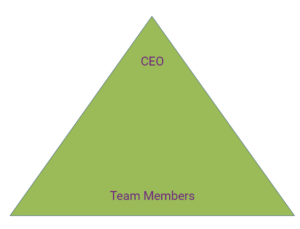
Greenleaf felt that servant leadership required a participatory form of leadership not just a single person at the top.
He said: “A lone chief atop a pyramid is abnormal and corrupting…none of us is perfect by ourselves and all of us need the help of correcting influence from close colleagues.”
A lone chief can hold too much power and sometimes those people at the top suffer from a very real loneliness.
Flaw #2: Pyramid
Oftentimes, leadership is seen as a pyramid with all the power at the top.
 You might then say that servant leadership is represented by an upside-down pyramid where the C-Suite Executives serve those they lead, who then serve those they lead, and so on with the team members or customer at the top.
Alternatively, Greenleaf invites you to think of organizational leadership not as a triangle but as a council of equals: a circle of equal input, high trust, and accountability.
Flaw #3: Perception

How we view and treat others is a direct reflection of our character as leaders.
George SanFacon shared this potential perception in his book, The Conscious Person’s Guide to the Workplace:
“I had to do a loving, kindness meditation everyday, multiple times a day, to see each person as a human and not as a threat.”
How do we view others with this genuine desire to serve and not get in our own way?
Flaw #4: Structure
There is so much structure in organizational life that it sometimes limits the best of us. Common structures that can get in the way include:
- Processes, rules & procedures
- Communication (too much, too little, not clear)
- Power dynamic (a.k.a. struggle)
Greenleaf says we need both Operationalizers & Conceptualizers in the workplace:
- Operationalizers carry the organization toward its objective (day-to-day).
- Conceptualizers are the strategic planners who look toward the future.
Yet rarely do these two types of people understand or appreciate the need for one another.
Where do you identify and how have you looked at the other? Are you open and interested in their perspectives? Do you make time to connect with them?
Encouraging Connection & Friendship at Work
Did you know we spend an average of 90,000 hours at work during our lifetime?
Interestingly, it also takes 90 to 200 hours to form a deep friendship, and surveys suggest that the workplace is where adults are most likely to make friends. In our virtual world, unfortunately, it is harder to build genuine friendships.
Tom Rath’s book, Vital Friends asks this question: Do you have a “vital friend” at work?

A “vital friend” is someone who:
- Measurably improves your life
- Is a person at work or in your personal life you can’t afford to live without.
In addition to reporting being overall happier, Rath shares research that when people have close friendships at work, they:
- Report a nearly 50% increased satisfaction with the company they work for.
- Have double the chances of a favorable perception of pay.
- Are seven times more likely to be engaged in their job.
The secret sauce for positively impacting employee engagement, productivity, organizational culture, and individual happiness is creating the conditions for friendship inside and outside the workplace.
It turns out that being a good friend and having good friends at work is good for business and a solid pillar of servant leadership teams!
A Different Perspective on Teams
After learning about organizational leadership flaws and seeing why having vital friends at work is so important, we challenge you to look at the team(s) you lead as a personal board of directors.
Your personal board of directors can help you achieve your goals, navigate challenging situations, and broaden your perspective.
Complete this Exercise:
- Draw a boardroom table on a piece of paper or mentally.
- Think about people who would be sitting around your personal and/or professional boardroom.
- Consider where you would sit as the chairman of your own personal board of directors?
When selecting people for your board, consider:
- Diversity: Having a diverse board can provide a wider range of perspectives and opinions.
- Interest in your success: Ideally, your board members should have a strong interest in your success.
- Personal and professional knowledge: Your board members should know you well and have your best interests in mind.
If you are thinking, “The quality of my friendships and relationships is not where I would like them to be.” Or, if you are leading a team where ‘friends’ would not describe the working relationships between members, then we hope you use this exercise to think about how to intentionally build and lead a servant leadership team that is going to drive success.
We understand that driving success on your team isn’t always as easy as outlined above, but it doesn’t have to be complicated either.
It starts with slowing down and looking at our mindsets/beliefs, as well as the actions we take. After shifting your perspective and redefining team dynamics based on the sharing above, we’re confident you’ll elevate your ability to achieve success and support greater team impact.
______________________________________________________________________
What have you learned from this blog? Let us know!
Don’t miss your opportunity to join our next conversation! Community of Practice sessions are amazing opportunities for any and all leaders to gather and learn from one another in a supportive, comfortable environment, right from your computer. October’s topic is “Thirsty for Wonder…Hungry for Curiosity.”
Additional Resources:
- Ann McGee-Cooper Video Library
- Ann McGee-Cooper Spirit of Servant Leadership Award
- The Conscious Person’s Guide to the Workplace by George SanFacon
- Vital Friends by Tom Rath
- Finding Your Third Place by Richard Kyte
______________________________________________________________________
This blog post wraps up September 2024’s Community of Practice conversation. To join us during the live discussion for future months, register at https://www.sophiapartners.org/events/. This program occurs the fourth Tuesday of each month from 11:30 a.m.-12:30 p.m. CT via Zoom.