Leading through Conflict: Mastering Conflict Thoughtfully
Conflict is an inevitable part of the workplace and relationship building. For some, it’s the uninvited guest in a meeting or the storm cloud on an otherwise sunny day.
Yet, within the dynamics of conflict lies the potential for extraordinary leadership and team building.
Paula Rauenbuehler, CEO and Founder of Leading UP, LLC, led our discussion on mastering conflict thoughtfully. Her background in emotional intelligence and neuroscience helps drive tangible results and can help you lead through conflict.
What is your relationship with conflict?
To start this exploration, let’s start with some personal leadership reflections: What is your relationship with conflict?
Some common connections to conflict include:
- Hide and seek = avoidance
- Give and take or mostly give up = accommodation
- Might makes right = aggression
Avoidance:
This is a common one. Many times it seems easier to avoid the conflict altogether instead of facing it head-on.
Accommodation:
If I give you all you want then there’s no conflict, but it still looks like I’m participating in the conversation. By giving in or “people pleasing” it feels like the conflict is resolved.
Aggression:
When you’re in your fear-based brain, your mind is trying to protect you because it perceives a threat so your words or demeanor can come out aggressive.
No matter what your relationship with conflict is today, use the conflict management tool below to help you approach conflict with structure so that you can dive into conversations feeling prepared and achieve the results you want!
Conflict: Whitewater rafting or lazy river?
Think about your relationship with conflict based on these two pictures:

For some people, going whitewater rafting on a Class 5 river would be exciting! Others may see that and say, “No way! That’s not for me.”

On the other hand, some people would prefer going on a lazy river and find it nice and relaxing. While for others, it would be unpleasant or even put them to sleep!
Based on these pictures, do you crave the adrenaline that conflict sparks or do you like to go with the flow and let conflict unfold on its own?
RAFT: Results, Actions, Feelings, Thoughts
All of you have experienced conflict at some point, whether that was in the workplace with a team member or supervisor, in the home with a partner, or maybe it was with a close friend or confidant.
In this section, think about a current or recent experience with conflict and use RAFT (Results, Actions, Feelings, Thoughts) as a tool to help you master conflict thoughtfully.
STEP 1: Answer the following questions in 1-2 sentences.
STEP 2: Use the Feelings Wheel to describe how you were feeling.
Results
Q: What result happened for you at the end of that conflict?
Actions
Q: What actions did you take in that conflict?
Feelings
Q: How were you feeling during the conflict?
Thoughts
Q: What were you thinking during the conflict?
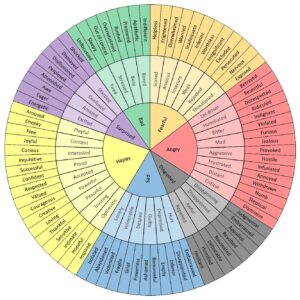
In this next section, think about a future conflict that you anticipate could happen and use RAFT (Results, Actions, Feelings, Thoughts) as a tool to help you master conflict thoughtfully.
STEP 1: Answer the following questions in 1-2 sentences.
STEP 2: Use the Feelings Wheel to describe what you want to feel.
Results
Q: What is the result you want from the conflict?
Actions
Q: What actions will you need to take to achieve the results you want?
Feelings
Q: What emotions would allow you to take or not take those actions?
Thoughts
Q: What thoughts do you need for these emotions to be the ones you access?
To have a different result when it comes to conflict, you have to start with your thoughts. When you change your thoughts, it changes your feelings, your actions, and finally, your results.
Conflict Management: Don’t get stuck!
Unfortunately, it’s easy to get stuck in the process of conflict management. Here are some common situations that occur:
Action – Result Loop
This happens when you get stuck in a pattern – not getting the result you want and/or doing the same thing expecting a different outcome.
For example: “I didn’t get the result I wanted, so I’m going to repeat the action until it changes the result.” It’s not until you take a step back and see what’s wrong with the action that you can break outside the loop.
Thought and Feeling
Conflict is your opportunity to choose what story you want to tell. Oftentimes we make stuff up. Sometimes it’s the truth and sometimes we make assumptions. Be careful of the stories you tell yourself and invite curiosity, not negativity.
“Between stimulus and response there is a space. In that space is our power to choose our response. In our response lies our growth and freedom.” – Viktor E. Frankl
Mastering conflict thoughtfully
The next time you’re stuck when conflict arises, ask these three questions. It’s important that both you and the other person can say “YES” to all three.
- Do you understand me?
- Do you care about me?
- Can I trust you?
These questions can help you get to a point where you and the other person understand each other and find resolution. You both may not agree, but you can work towards understanding.
Use these questions and the RAFT tool to plan your day and maintain your energy, not getting stuck in conflict, but rather finding opportunities to lead through conflict!
About Paula

Paula is a seasoned leadership coach and HR expert. As CEO/Founder of Leading UP, she leverages her extensive corporate and coaching experiences to help organizations thrive. With nearly 1,000 coaching hours, Paula is a trusted partner in building high-performing teams and leaders.
Her focus on emotional intelligence and neuroscience drives tangible results, helping clients achieve both personal and professional success.
______________________________________________________________________
What have you learned from this blog? Let us know!
Don’t miss your opportunity to join our next conversation! Community of Practice sessions are amazing opportunities for any and all leaders to gather and learn from one another in a supportive, comfortable environment, right from your computer. September’s topic is “Leading (Servant Leadership) Teams.”
Additional Resources:
______________________________________________________________________
This blog post wraps up August’s 2024’s Community of Practice conversation. To join us during the live discussion for future months, register at https://www.sophiapartners.org/events/. This program occurs the fourth Tuesday of each month from 11:30 a.m.-12:30 p.m. CT via Zoom.